
Space elevators
Should we have very long “ladder” (as in 36000kms long) that co-rotates along with Earth and connects the surface with a geostationary orbit space station very high up?
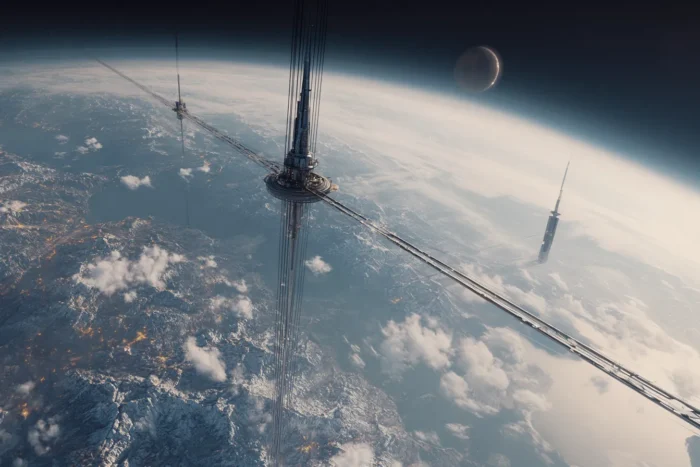
Space elevators are groundbreaking concepts that aim to revolutionise access to space by providing a cost-effective and continuous link between Earth and orbit.
Here’s what they are, how they might work, their components, feasibility, and some of the real-world plans under consideration.
What are space elevators?
A space elevator is a megastructure consisting of a super-strong cable anchored to the Earth’s surface, extending up to a counterweight in geostationary orbit—about 35,786 km above the equator.
Electrically powered climbers would ascend this cable, carrying cargo and potentially people into space, dramatically reducing the reliance on conventional rockets.
Key parts of a space elevator
A typical space elevator would include:
Earth Anchor & Base Station: Usually located at the equator, often proposed on an ocean-based platform to minimise environmental and geopolitical risks.
Tether/Cable: The critical component, made from a material with extraordinary tensile strength and low density, such as carbon nanotubes or graphene nanoribbons.
Counterweight: Placed beyond geostationary orbit, it maintains tension in the tether by balancing Earth’s gravity and centrifugal force.
Climber Vehicles: Electrically powered vehicles would move up and down the tether to move payloads between Earth and space.
Feasibility and challenges
Space elevators have strong theoretical underpinnings but face daunting practical barriers:
Materials: The main hurdle is synthesising tether materials long and strong enough to bear the forces involved. Carbon nanotubes and graphene are promising, but today’s technological limitations prevent large-scale production suitable for space elevators.
Engineering: Managing a 35,000+ km-long structure presents immense challenges in stability, vibration control, shielding against space debris (including satellites and other debris), and mitigating atmospheric weather at the lower end.
Economics: Initial construction cost estimates range from $10 to $100 billion, but once operational, a space elevator could slash transport costs to as low as $200 per kilogram. Economic viability is expected only when cheaper manufacturing materials are available.
Technology readiness: Currently, advancements in material science are needed before these concepts become feasible.
International political challenges: Although the ISS is a collaborative effort among many countries, it does not include China. A full cooperation between everyone seems impossible.
Real plans
Although no space elevator has been built, there are real plans and serious discussions:
Obayashi Corporation: Proposed building a space elevator by 2050; they are researching materials and engineering solutions, but no construction has begun.
International Space Elevator Consortium: Organises conferences, publishes feasibility research, and collaborates with institutions to promote the concept and solve its technical challenges.
Lunar and Martian Elevators: Some recent concepts see building smaller-scale elevators on the Moon or Mars as a stepping stone, since their lower gravity dramatically reduces material requirements. Lunar elevators are considered more attainable in the short term.
Recent Engineering Studies: Some engineers suggest that materials and concepts available today could support limited, alternate designs, such as ‘spacelines’ or using near-Earth objects as construction anchors, but these are not yet close to implementation
Conclusion
Space elevators could revolutionise humanity’s access to space, lowering costs and opening new frontiers for science, travel, industry…
Their realisation depends on future breakthroughs in materials, engineering, and international cooperation.
Should they be made real? Are they worth it?
Now that SpaceX has made rocket reusability possible, the efforts to make the trip from Earth to the tether’s end at about 100kms/hour (~15-day trip) seem further now than ever.